Best Pool Finishes for the Las Vegas Climate
Published cost and life-span estimates for plaster, quartz, pebble and tile, plus what to ask about coping, decking, start-up and hard water in Southern Nevada.
On this page
Choosing a finish for a Las Vegas pool means thinking about summer heat, strong sun and hard municipal water, not just how a sample board looks. This guide compares interior finishes, waterline tile, coping and decking with that climate in mind. There is no single “best” finish; there are trade-offs you can choose deliberately.
What the climate does to surfaces
Heat. The National Weather Service lists average July highs of 104.6 degrees for 1991 to 2020 in Las Vegas, with June at 99.6 and August at 102.9 (NWS). SNWA notes that warmer water means higher evaporation rates.
Hard water. The Las Vegas Valley Water District reports hardness around 280 parts per million, or 16 grains per gallon (LVVWD). As water evaporates, the minerals stay. SNWA estimates an uncovered in-ground pool loses 48.6 gallons per square foot per year to evaporation (SNWA). Top-off water adds more minerals.
Sun. Summer sun heats exposed deck and coping surfaces. Ask manufacturers how their colors and materials perform in full sun.
The National Plasterers Council notes that fill water with extremely high or low calcium hardness, pH or alkalinity may require changes to start-up procedures, and that maintaining proper water chemistry is vital to achieving a finish’s expected lifespan (NPC).
Interior finishes compared
Published national estimates for resurfacing give a sense of relative cost and life span. These are HomeGuide’s national figures for resurfacing roughly 1,000 square feet of surface, not new-construction prices and not Las Vegas quotes (HomeGuide).
| Finish | Texture and look | Published resurfacing estimate (national) | Published life span (national) | | --- | --- | --- | --- | --- | | Standard white plaster (marcite) | Smooth; bright, classic blue water | $6,000 to $8,000 | 7 to 12 years | | Quartz plaster | Smooth to slightly textured; speckled color | $7,000 to $10,000 | 10 to 15 years | | Aggregate | Exposed particles | $6,000 to $15,000 | Not separately stated | | Pebble | Rounded pebbles; natural look | $7,000 to $15,000 | 15 to 20+ years | | Full tile | Glass, porcelain or ceramic | $8,000 to $30,000+ | Longest-lasting option, per HomeGuide | | Polymer coatings | Sprayed thermoplastic | $10,000 to $15,000 | Not stated here |
Ask any installer how water chemistry and start-up care affect the life of the finish they propose, and ask what their warranty covers and what water-balance conditions it requires.
A note on color
Interior color changes the look of the water. The Southern Nevada amendments to the 2024 pool code address interior finish color, requiring finishes to be not less than 6.5 on the Munsell gray scale, with listed exceptions such as waterline tiles, step edge markings and approved rock features (Southern Nevada ISPSC amendments). Ask your builder how your jurisdiction applies this to the color you are considering before you commit.
Start-up is part of the finish
The National Plasterers Council says the first 28 days are when an interior finish is most susceptible to staining, scaling and discoloration. It recommends a continuous, uninterrupted fill, daily testing, frequent brushing, no heater for 28 days, and waiting on wheeled cleaners until plaster dust clears, typically 7 to 10 days. It also says not to fill with softened or reverse-osmosis water, and to test fill water for pH, alkalinity, calcium hardness and metals (NPC). Proprietary finishes follow their manufacturers’ instructions. Agree in writing on who performs start-up.
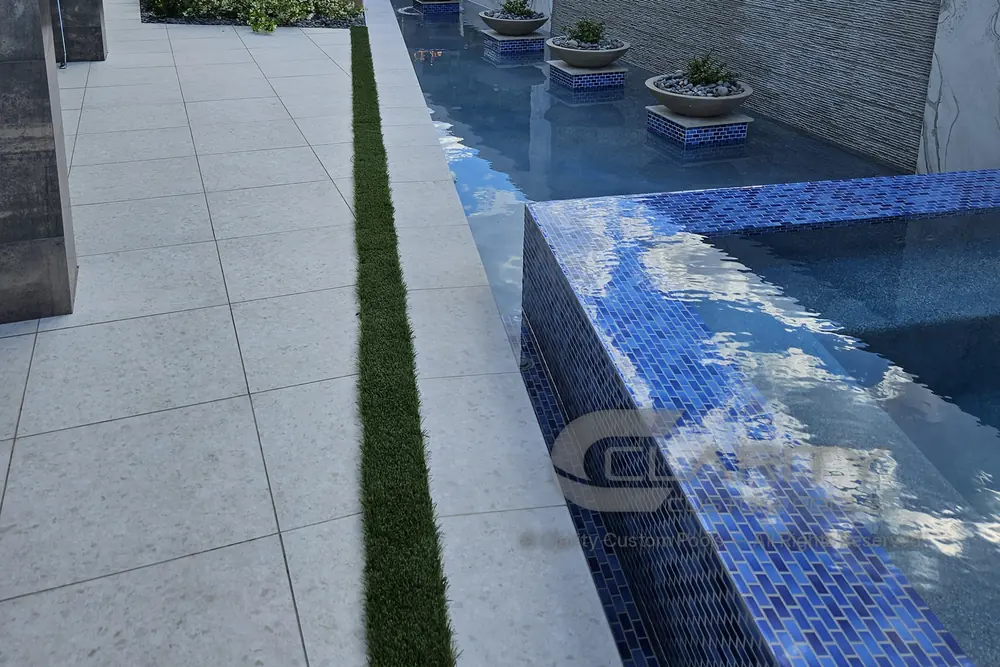
Waterline tile
Most pools have a band of tile at the waterline, where evaporation can leave a mineral line. Common choices include glass, porcelain, ceramic and natural stone tile. Ask your installer and the tile manufacturer:
- How the tile is rated for pool waterline use.
- Whether it needs sealing, and how often.
- Which cleaning methods and products it tolerates, so you avoid damaging glazes or glass.
Whatever tile you choose, keeping water chemistry in range and using a cover to limit evaporation (SNWA says covers reduce evaporation by 90 percent) both help at the waterline.
Coping
Coping is the cap on the pool wall, the surface you sit on and hands grip.
Common coping options include poured-in-place concrete, precast concrete, travertine and other natural stone, and paver or bullnose units that match a paver deck. Ask to see samples in the sun, ask whether the material needs sealing, and ask how the coping and deck details handle drainage. The Southern Nevada amendments require site drainage to direct drainage from the site, perimeter decks and roofs away from the pool or spa and adjacent buildings (Southern Nevada ISPSC amendments).
Decking
Deck surfaces get hot in a Las Vegas summer. Ask about color, material, texture and shade when you choose a deck.
| Deck option | Published national installed cost | | --- | --- | --- | | Poured concrete | $5 to $15 per sq ft | | Stamped concrete | $8 to $19 per sq ft | | Pavers | $10 to $17 per sq ft | | Natural stone | $16 to $35 per sq ft | | Flagstone | $15 to $32 per sq ft |
Costs from HomeGuide’s pool deck guide (national patio estimates).
Practical tips:
- Test samples in the sun. Put samples outside on a summer afternoon and touch them.
- Ask about color and surface temperature for the areas where people walk barefoot.
- Ask about cool-deck-style coatings, textured acrylic toppings designed for pool decks. Ask the manufacturer or installer for performance information; claims vary.
- Plan shade. Patio covers, trees or shade sails can shade the deck. These may be separate trades.
- Watch drainage. Southern Nevada’s pool code amendments require drainage from perimeter decks to be directed away from the pool and adjacent buildings.
Keeping finishes looking new in hard water
- Test regularly. CDC recommends checking chlorine and pH at least twice a day for health reasons (CDC); test calcium hardness, alkalinity and dissolved solids on a regular schedule too.
- Hold pH in range. CDC recommends pH 7.0 to 7.8.
- Use a cover. SNWA says covers reduce evaporation by 90 percent.
- Brush. The National Plasterers Council calls for frequent brushing during start-up and regular brushing as part of ongoing care.
- Ask about mineral levels. Ask your service provider what to do if calcium or dissolved solids climb. If you drain, SNWA says pool water must go to the sanitary sewer.
- Do not leave a pool empty. SNWA advises refilling as soon as possible after draining because direct sun can damage exposed plaster.
Frequently asked questions
What pool finish lasts longest in Las Vegas?
HomeGuide's national estimates list pebble at 15 to 20+ years and tile as the longest-lasting option, compared with 7 to 12 years for standard plaster. Actual life depends on water chemistry and start-up care.
Why is there a white line on my waterline tile?
A line at the waterline is often mineral deposits left behind as water evaporates. Keep water chemistry in range, reduce evaporation with a cover, and ask your tile installer which cleaning methods are safe for your tile.
Do dark pool finishes make sense here?
Southern Nevada's pool code amendments set a minimum Munsell gray scale value for finishes, with listed exceptions. Ask your builder to confirm your color complies before you commit.
What is the coolest deck material?
No source we cite ranks deck materials by temperature. Test samples in full sun on a summer afternoon, ask manufacturers for performance information, and add shade where you can.
Sources
- HomeGuide, "Pool Resurfacing Cost" homeguide.com
- HomeGuide, "Pool Deck Cost" homeguide.com
- National Weather Service Las Vegas, Monthly and Seasonal Average High Temperatures weather.gov
- Las Vegas Valley Water District, Water Quality Report lvvwd.com
- Southern Nevada Water Authority, "Pools and spas" snwa.com
- Southern Nevada Building Officials, Southern Nevada Amendments to the 2024 ISPSC sawebfilesprod001.blob.core.windows.net
- National Plasterers Council, "Tips on Filling the Pool and Initial Start Up" nationalplastererscouncil.com
- CDC, "Home Pool and Hot Tub Water Treatment and Testing" cdc.gov
Related guides
Equipment
Pool Equipment Explained
What each piece on the equipment pad does, how the choices differ, and what hard water, heat and local drainage rules mean for pumps, filters, heaters and salt cells in Las Vegas.
Pool Design
Pool Design Considerations for Las Vegas Backyards
Designing a pool for a Las Vegas yard means working within a 600-square-foot limit, setbacks and block walls, and planning around sun, shade and evaporation. Here is what to consider.
Building a Pool
How Much Does a Pool Cost in Las Vegas?
Published national estimates put most inground pools somewhere between the mid-$40,000s and $120,000. Here is what can move a Las Vegas pool budget, line by line.