Commercial Pool Construction in Las Vegas
Apartment and HOA pools are generally treated as public aquatic venues in Southern Nevada. That means Health District plan review before any work, specific inspections and a closeout package. Here is how the process works.
On this page
A pool at an apartment community, condominium, HOA clubhouse, hotel or fitness facility is regulated differently from a backyard pool. In Southern Nevada it is generally treated as a public aquatic venue, regulated by the Southern Nevada Health District in addition to the local building department. The design standards are different, the approvals come in a set order, and the project is not finished until the closeout documents are accepted and the health permit is issued. This guide is written for HOA boards, property managers and owners’ representatives planning new construction or a remodel. Confirm current requirements with each agency; they update forms and procedures.
Who regulates a commercial or HOA pool
Southern Nevada Health District (SNHD). SNHD’s Aquatic Facility Regulations, based on the CDC’s Model Aquatic Health Code, took effect July 1, 2019 (SNHD regulations). SNHD defines an aquatic venue as any artificially constructed structure where the general public is exposed to water intended for recreational or therapeutic purposes, and prohibits operating an aquatic facility without a valid permit from the Health District. Any owner planning to construct or remodel an aquatic venue must apply and receive written approval before starting work (SNHD plan review). The state framework is Nevada Revised Statutes and Administrative Code Chapter 444; SNHD notes that NAC 444 served as its governing document before its own regulations (NAC 444).
The local building department. Clark County, Las Vegas, Henderson or North Las Vegas issues the building permit. Health approval comes first. The City of Las Vegas states that a permit for a commercial pool will not be issued until SNHD has reviewed and approved the design (City of Las Vegas); Clark County requires Health District approval of treatment, filtration and recirculation plans before a permit application for public pools and uses a separate commercial pool/spa application, BPA-008 (Clark County BPG-185; forms).
The Nevada State Contractors Board. Pool construction falls under subclassification A-10, which covers commercial and residential pools (NAC 624.150).
Health District plan review
When it is required
SNHD requires new construction or substantial alteration review when constructing a new aquatic venue or facility, completely removing and replacing one, or substantially altering one, such as altering the shell, changing volume or replacing all plumbing (SNHD new construction).
Smaller projects can still need review. SNHD’s non-substantial alteration page lists adding to or altering a venue, altering equipment or structure, and replacing equipment with non-identical equipment. It also states that changing interior finish material or color triggers a submission, and that replacing suction outlet fitting assemblies (SOFAs) during a replaster requires an alteration submission regardless of finish, with a SOFA worksheet (SNHD non-substantial alteration). HOA boards planning a replaster should check with SNHD whether this review applies.
Who can submit
Plans and applications must be submitted by a Nevada-registered professional engineer, a Nevada-registered architect, or a licensed contractor holding a classification A license with an A-10 subclassification, with a current copy of the license included.
The process
| Step | What happens | Notes from SNHD |
|---|---|---|
| 1. Preliminary meeting (optional) | Discuss project specifics | Request through SNHD’s preliminary meeting application |
| 2. Intake meeting | Submit application and plans | Bring recorded ownership documents with APN, Health Permit Applications and Certification of Contracted Services; fees due at submission |
| 3. Plan review | Initial review of plans and application | No expedited process; approval not guaranteed on first review |
| 4. Corrections | Resubmittals as needed | Additional review time required |
| 5. Construction inspections | Scheduled by the facility | Excavation and plumbing; pre-plaster; final permitting inspection |
| 6. Health permit | Venue permitted to operate | Change of Permit Holder process if ownership transfers |
SNHD says the permit holder, rather than the design professional or contractor, now completes the Health Permit Application and Certification of Contracted Services, and that environmental health applications have moved to an online portal.
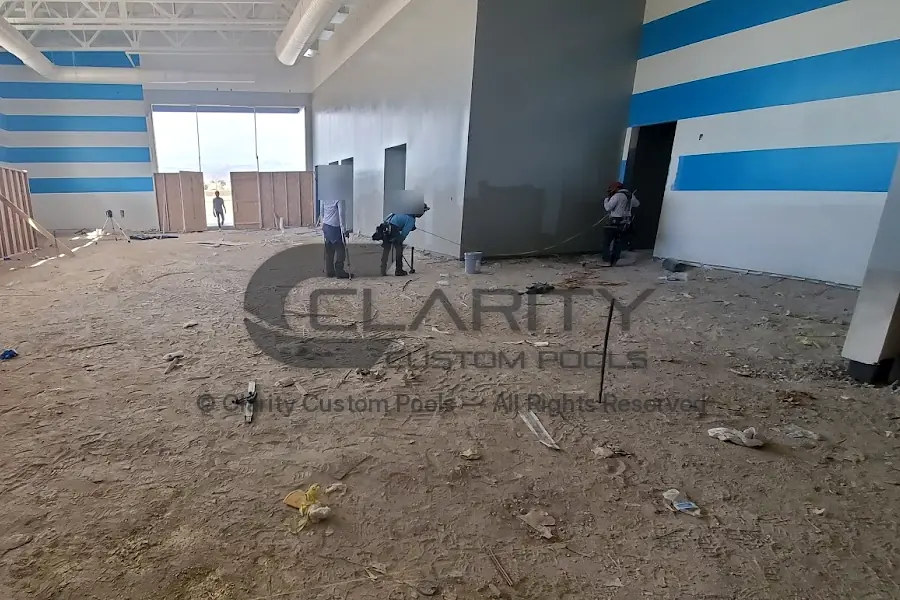
Layout: marking the pool outline before excavation.
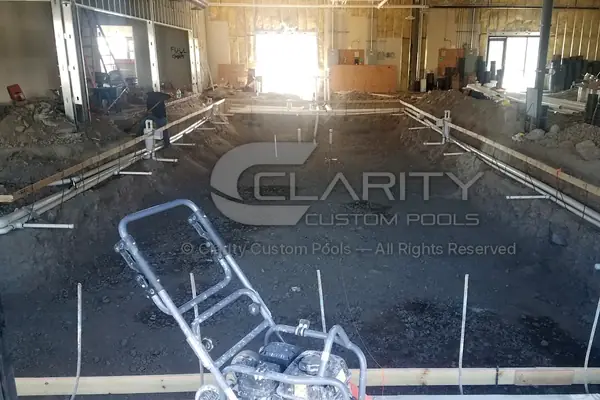
Excavation: forms set and plumbing stubbed up.
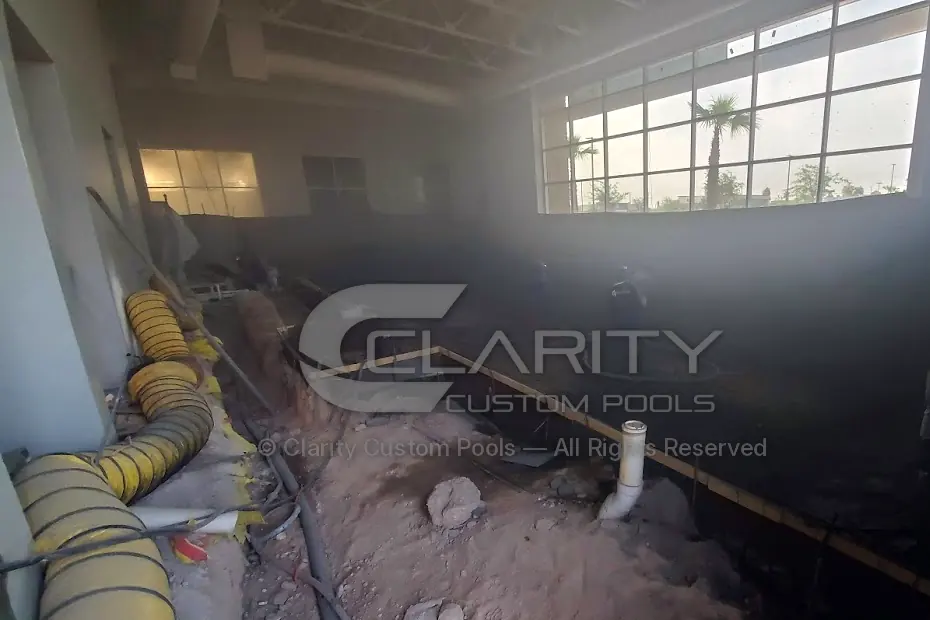
Shotcrete: the shell is sprayed in place.
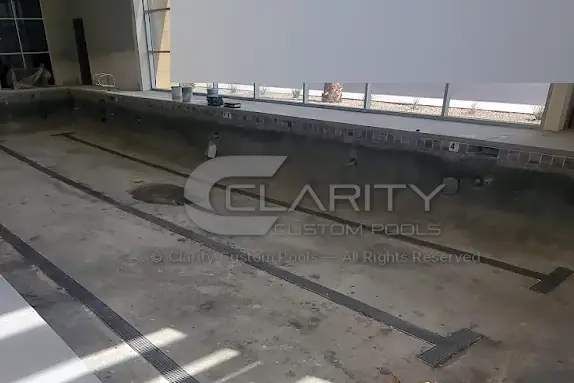
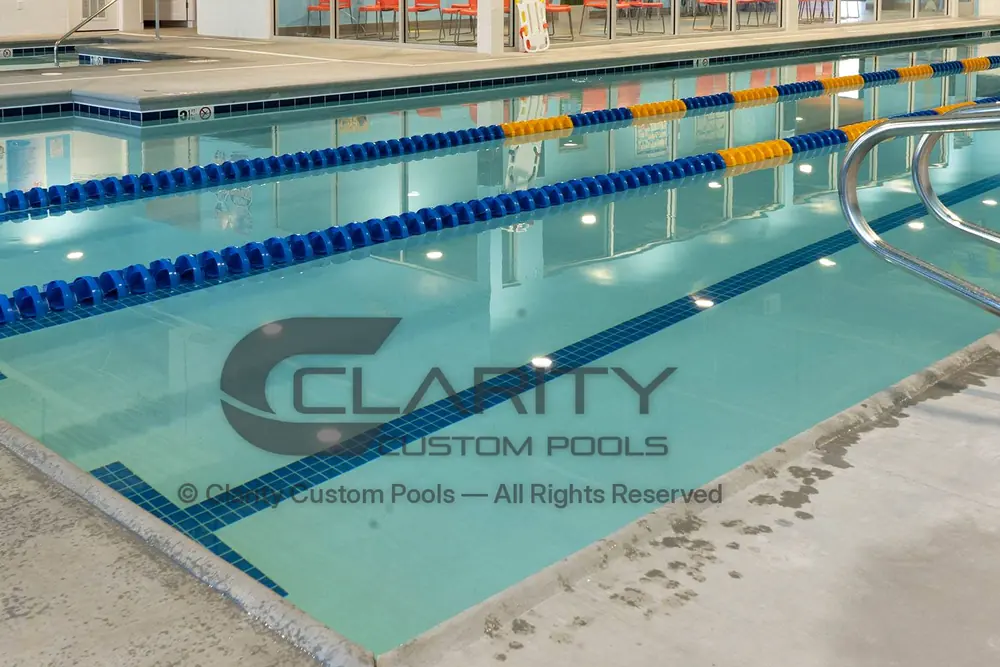
Tile: lane lines and waterline tile before fill.
Common causes of delay
SNHD lists incomplete information, incorrect plan scale, missing equipment specifications, inconsistencies between plans and applications, incorrect equipment or pipe sizing, design changes after submittal or approval, emergency egress conflicts, and insufficient lighting or photometric details. Ask your design team how it will address each of these items before submittal.
Design differences from residential pools
The Southern Nevada amendments to the 2024 ISPSC include public-pool provisions (amendments):
- Barrier height of at least 72 inches for public pools and spas, versus 60 for dwellings.
- Turnover: for Class A, B and C pools, hours equal 1.5 times the average depth in feet, not to exceed 6 hours; wading pools 0.5 hours.
- Floor inlets for pools wider than 35 feet, spaced no more than 15 feet apart; wall inlets no more than 15 feet apart along the waterline.
- Shallow-area floor slope not exceeding 1 in 12, except where accessibility requires otherwise.
- Special inspections under the building code for commercial or public pools and spas.
- Floor drains in sanitary facilities serving public pools.
- SNHD review first: the amendments say public swimming pools shall first be reviewed and approved by the Southern Nevada Health District.
Federal law adds anti-entrapment requirements. Since December 19, 2008, public pools and spas must have drain covers compliant with 16 CFR part 1450, and a pool with a single blockable drain, or multiple drains less than three feet apart on the same plane, needs a secondary anti-entrapment device or system (CPSC).
Water rules matter for amenities too. SNWA’s restrictions prohibit new commercial fountains and water features, with exemptions that include recreational water parks and mostly indoor features (SNWA). SNWA also describes a state law that prohibits using Colorado River water from SNWA member agencies to irrigate nonfunctional grass beginning in 2027 on properties not zoned exclusively for single-family residences, including commercial and multifamily properties. Ask how this affects landscaping plans around a community pool.
Closeout documentation
Commercial pool projects end with paperwork. Under SNHD’s Aquatic Facility Regulations (AFR PDF):
- Certificate of construction compliance. Required for new construction and substantial alterations, prepared by a licensed professional, stating that the facility, equipment and appurtenances were built and installed per approved plans and specifications.
- Commissioning and test reports. If systems such as lighting, air handling, recirculation, filtration or disinfection are commissioned or tested, those reports must be included.
- Approved plans on file. The owner must keep at least one set of approved plans available to SNHD for as long as the facility operates.
- Operations manual. Each facility must develop one, and the regulations reference keeping operation manuals for mechanical equipment.
- Qualified operator. The regulations require a qualified operator, defined as an individual with an active Health District registration, and the operator’s information must be posted at the facility.
Practical closeout checklist for owners: final SNHD inspection sign-off and health permit; building permit final; certificate of construction compliance; as-built or record drawings; equipment submittals with model and serial numbers; SOFA documentation; commissioning reports; operation and maintenance manuals; warranties; lien releases; and training for the operator.
Remodels and equipment replacement
For like-for-like replacements of pumps, filters, feeders, controllers and valves, the regulations allow substantially similar equipment (identical hydraulics) after contacting SNHD to review the change, and require the owner to submit technical verification that a like replacement equals the approved equipment within 5 business days of installation. Equipment that is not substantially similar needs an alteration submission. When in doubt, call SNHD at (702) 759-0572 or email aquatic@snhd.org before ordering equipment.
Frequently asked questions
Does an HOA pool need a health permit in Las Vegas?
HOA, apartment and other pools used by the public or residents collectively are generally aquatic venues under SNHD's regulations, which require a valid health permit and written approval before construction or remodeling. Confirm your facility's status with SNHD.
Can the building permit be issued before Health District approval?
Not in the City of Las Vegas, which says it will not issue a commercial pool permit until SNHD approves the design. Clark County also requires Health District approval first for public pools.
Does a replaster require SNHD review?
SNHD says a non-substantial alteration submission is required if the interior finish material or color changes, and whenever suction outlet fitting assemblies are replaced during a replaster.
What documents close out a commercial pool project?
Under SNHD's regulations, a certificate of construction compliance from a licensed professional, any commissioning or test reports, approved plans kept on file and an operations manual, plus the building permit final and contract closeout items.
Sources
- Southern Nevada Health District, Plan Review - Aquatic Facility southernnevadahealthdistrict.org
- Southern Nevada Health District, New Construction and Major Remodels southernnevadahealthdistrict.org
- Southern Nevada Health District, Non-Substantial Alteration (Remodel) southernnevadahealthdistrict.org
- Southern Nevada Health District, Aquatic Facility Regulations southernnevadahealthdistrict.org
- Southern Nevada Health District, 2018 Aquatic Facility Regulations (PDF) southernnevadahealthdistrict.org
- Nevada Administrative Code, Chapter 444 leg.state.nv.us
- Nevada Administrative Code, Chapter 624 (NAC 624.150) leg.state.nv.us
- City of Las Vegas Building & Safety, Pool/Spa/Water Feature Application files.lasvegasnevada.gov
- Clark County, Swimming Pool/Spa, Water Feature Building Permit Guide (BPG-185) clarkcountynv.gov
- Clark County Building, Application Forms clarkcountynv.gov
- Southern Nevada Building Officials, Southern Nevada Amendments to the 2024 ISPSC sawebfilesprod001.blob.core.windows.net
- U.S. Consumer Product Safety Commission, Pool and Spa Drain Covers cpsc.gov
- Southern Nevada Water Authority, "Understand Laws and Ordinances" snwa.com
Related guides
Building a Pool
Pool Permits and Approvals in Southern Nevada
A residential pool in the Las Vegas Valley can involve a building department, a water agency, an HOA and the state contractors board. Here is who approves what, with links to each official source.
Equipment
Pool Equipment Explained
What each piece on the equipment pad does, how the choices differ, and what hard water, heat and local drainage rules mean for pumps, filters, heaters and salt cells in Las Vegas.
Building a Pool
How to Choose a Pool Builder in Las Vegas
Skip the star ratings. Here is how to verify a Las Vegas pool contractor with the state, compare bids on equal terms, and recognize the warning signs before you sign.